CAPSTONE PROJECT
OptiTax
Product Designer
Date
Jan 2026 – May 2026
Role
Product Designer
Tools
Figma
Methods
Interview
Competitor Analysis
The Big Idea
Turn taxes into a real-time decision system that helps users make smarter financial decisions and keep more of what they earn through AI and tax simulation.
Problem Statement
High-income earners make investment decisions without understanding real-time tax impact
Users are surprised by large tax bills, lose tens of thousands through poor timing, and delay important financial decisions due to uncertainty, often leading to stress and last-minute scrambling during tax season.
This is not just inefficiency, it is costly mistakes and stress at tax time.
Design Challenge
Users make decisions based on returns alone, ignoring tax implications, and only realizing the consequences at the end of the year.
The User
High-income earners who need to make frequent financial decisions
The goal is to help users make faster, more informed decisions by providing clear visibility and embedding tax awareness, while reducing missed optimization opportunities throughout the year.
It is not about whether users can use the app, but rather who will use it frequently and consistently, who gains the most value from it, and who needs it most.
The User
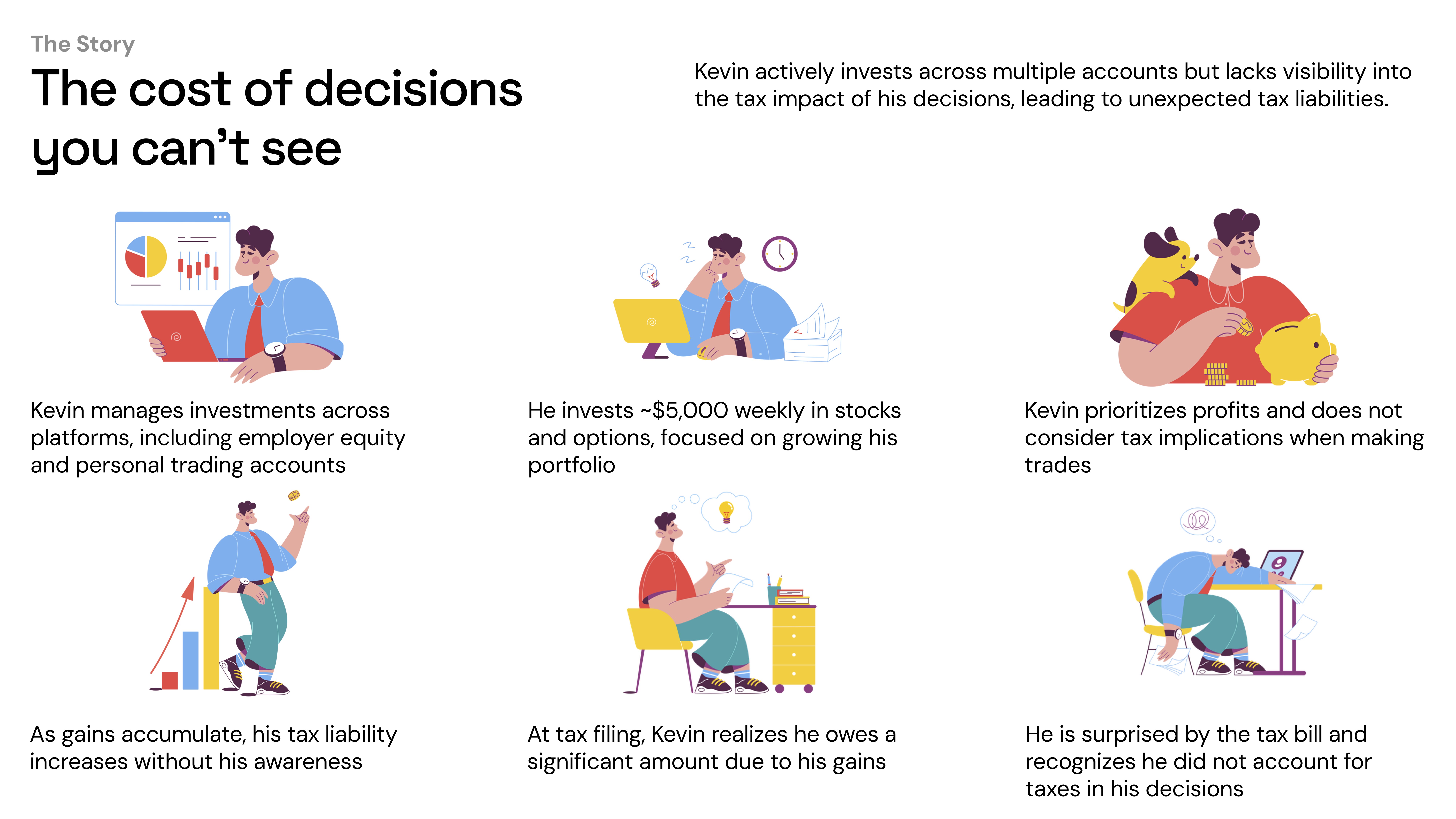
Fragmented data and tax anxiety drive avoidance, creating a need for a unified, real-time view of total liability
Avoidance driven by anticipated tax burden
Users delay taxes due to anticipated payments, leading to stress and missed planning opportunities, highlighting the need for real-time visibility into tax liability and how decisions impact it.
Complex and limited understanding of tax rules
Limited understanding of tax rules like wash sales and capital gains leads to disallowed losses and higher tax bills, creating a need for AI-driven recommendations that proactively suggest which assets to sell or hold.
Fragmented financial data across platforms
Users manage multiple brokerage accounts, making it difficult to see total gains and highlighting the need for a unified view.
Uncertainty in 401(k) contribution strategy and limits
Users struggle to choose the right contribution strategy and risk overcontributing due to limited visibility, leading to penalties and extra administrative work.
Final Solutions
I designed a unified financial dashboard that uses AI to surface tax optimization opportunities to address fragmented data and tax anxiety
01
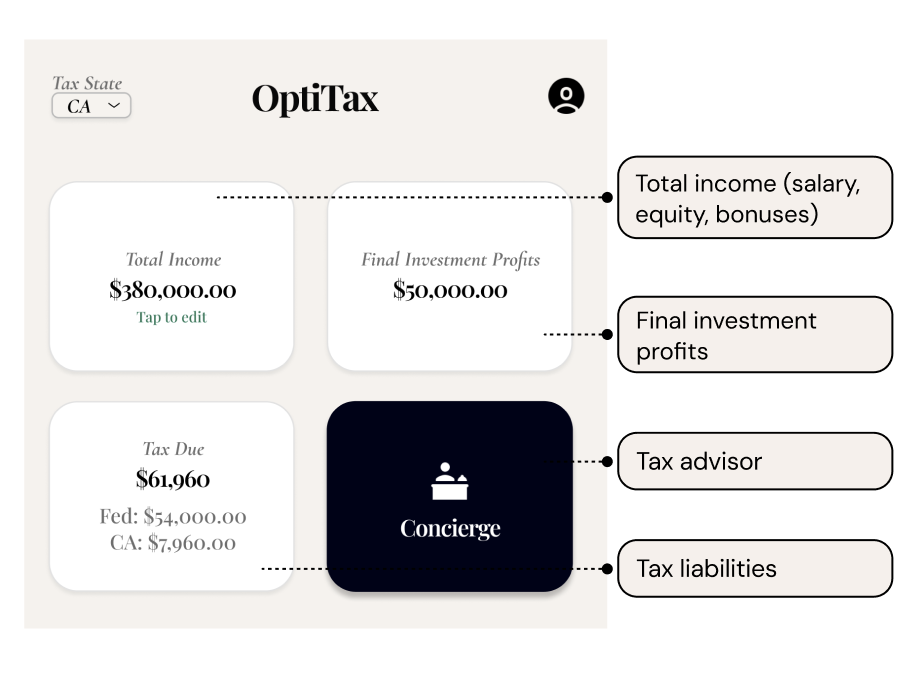
Kevin views his total income, profits, and tax liabilities in one snapshot
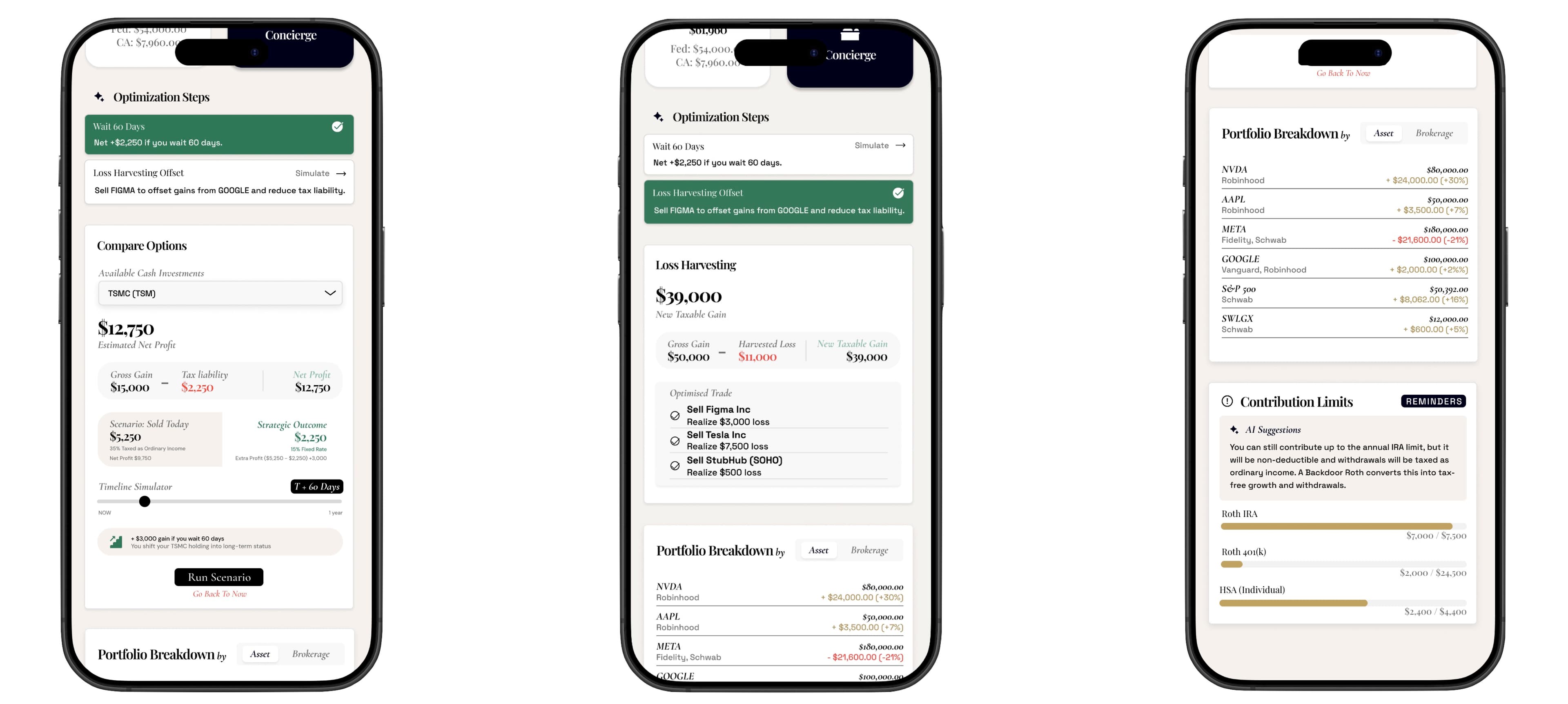
Kevin needs to understand how income and investments affect his tax liability before making financial decisions. I designed a dashboard that shows total income, investment profit, estimated tax due, real-time tax impact, after-tax returns, and personalized next steps. As a result, Kevin gains clarity, reduces uncertainty, and makes more informed tax-aware decisions before taking action.
02
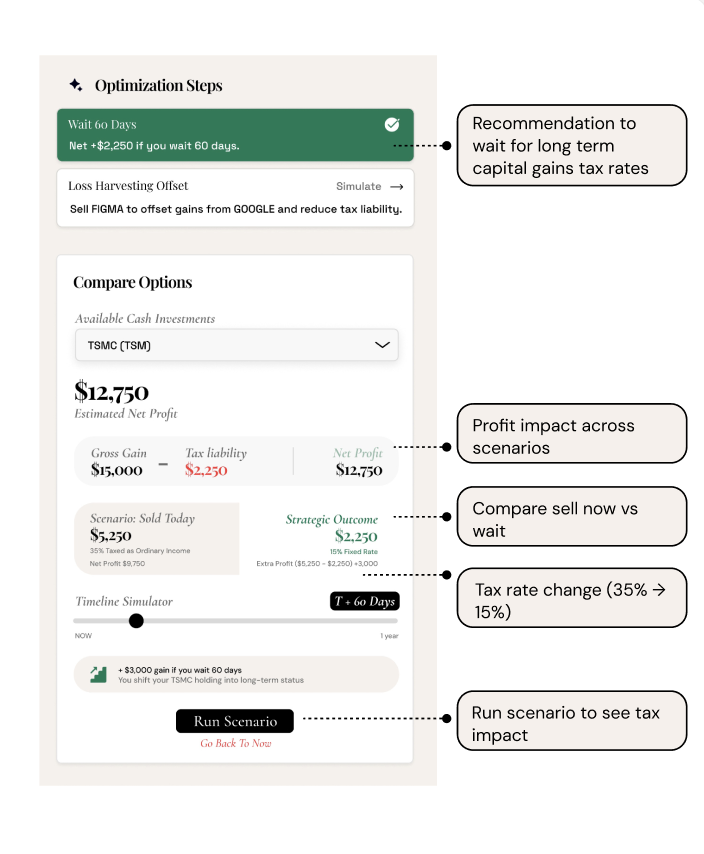
Next, Kevin decides if he wants to sell today vs waiting X months
Kevin needs to decide whether to hold or sell investments based on tax timing and net profit. I designed an AI-driven optimization feature that compares selling today, in 60 days, or in one year, showing tax liability and after-tax returns. As a result, Kevin can evaluate trade-offs, choose the best option, and improve his final take-home profit.
03
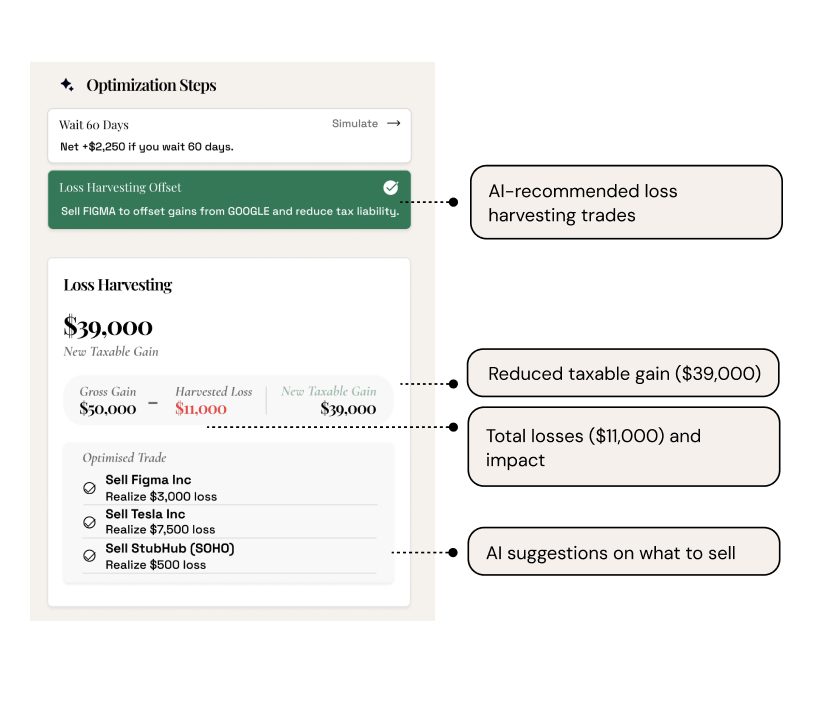
Next, Kevin evaluates whether to offset gains
Kevin needs to reduce tax impact before selling a stock with significant gains. I designed a tax-loss harvesting simulation that identifies an $11,000 loss in another account, reducing taxable gains from $50,000 to $39,000. As a result, Kevin lowers his tax liability, increases after-tax returns, and turns an unrealized loss into financial advantage.
04
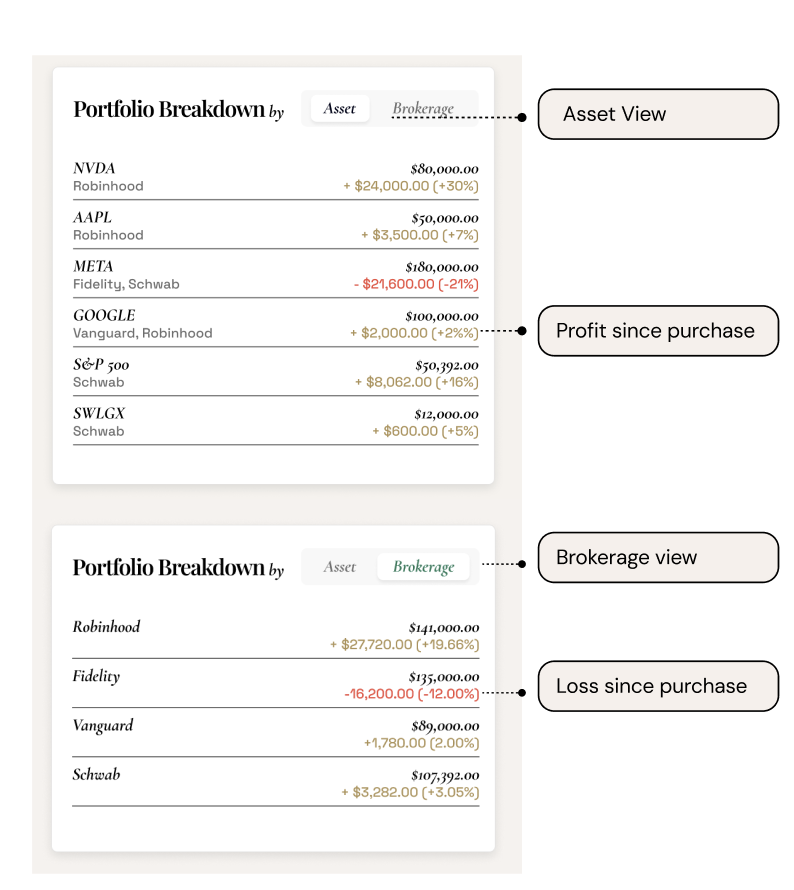
Next, Kevin evaluates his asset and brokerage overview
Kevin needs to decide which assets to hold or sell across multiple accounts to manage tax impact. I designed a portfolio breakdown that consolidates all assets and brokerages in one place. As a result, Kevin reduces fragmentation, avoids switching between apps, and makes more confident tax-aware investment decisions.
05
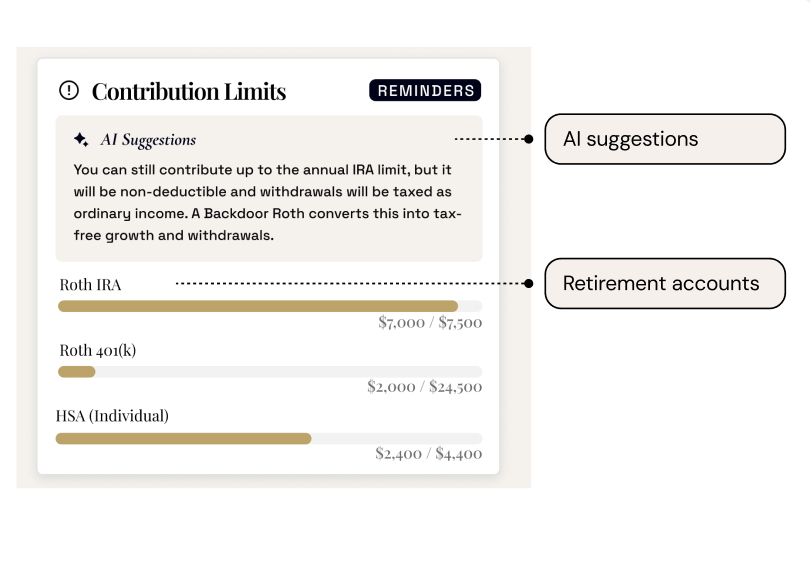
Next, Kevin uses AI reminders and guidance to optimize retirement contributions
Kevin needs to allocate remaining retirement contributions without penalties or lost tax advantages. The system compares IRA, 401(k), and HSA contribution room, flags non-deductible IRA risk, and recommends a Backdoor Roth strategy. As a result, Kevin avoids a 6% overcontribution penalty, reduces future tax exposure, and makes a smarter long-term contribution decision.